October 13, 2026

Darling Gomez sailed 22 years to become OSG’s first female captain

She was once the only woman aboard. Today, four women crew the tanker she commands.

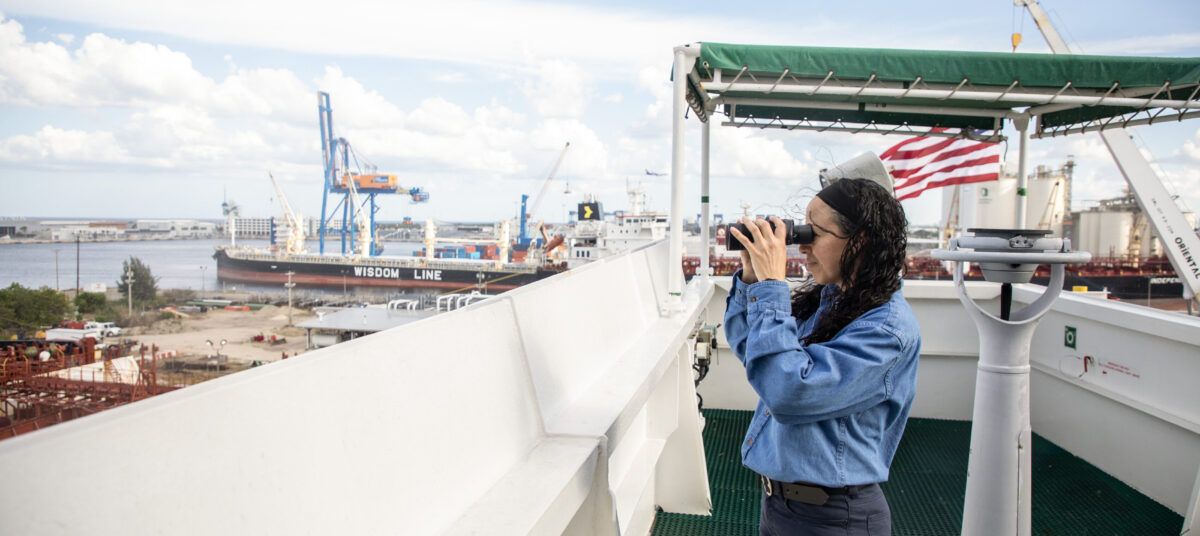
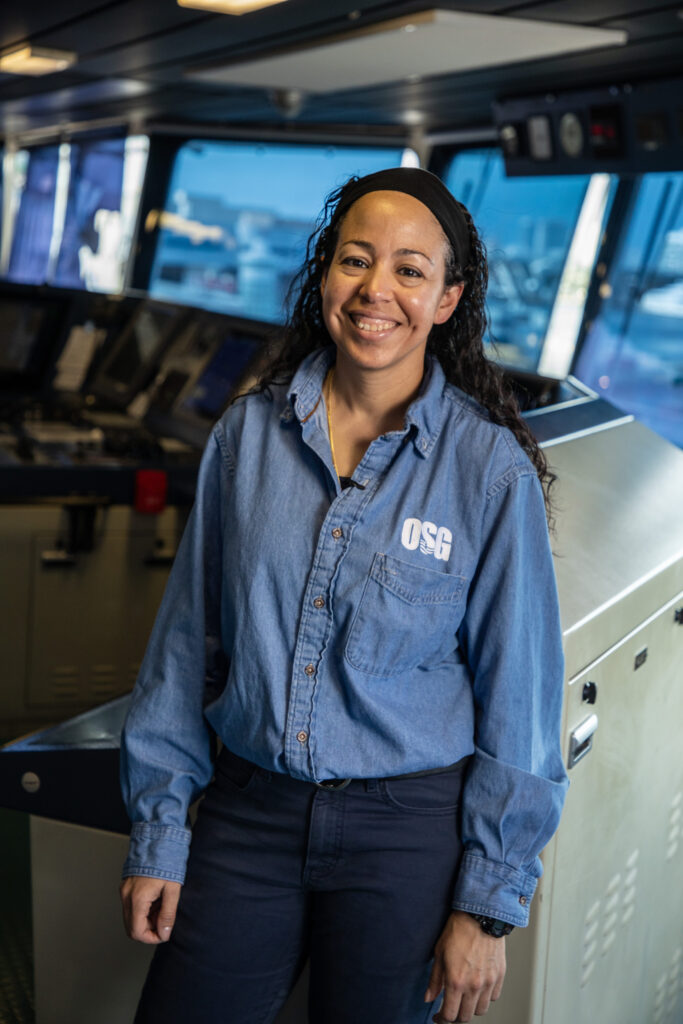
Captain Darling Gomez took command of the OVERSEAS MARTINEZ on June 16, 2026. Six weeks in, sitting for an interview aboard the tanker, she was still absorbing what the job actually meant.

“You don’t know until you do it what’s in it,” she said. “They can only tell you and you can see what’s happening while you’re not in charge. But until you’re in charge, that’s when you really know.”

Gomez is the first female captain in the Overseas Shipholding Group (OSG) fleet.

Twenty-two years ago, she walked into an OSG office in New York City for a two-week internship. She was a senior at SUNY Maritime, about to graduate with her merchant mariner license. She told the office she wanted to work there when she graduated. Then she waited for the call.

They called. She’s been at OSG ever since.
From the Bronx to Fort Schuyler

Gomez was born in the Dominican Republic and moved with her family to New York City at 11. She grew up in the Bronx. Her family had no maritime background: no captains, no naval officers, no shipboard cousins.

“I had no idea this existed,” she said.

What she did know about was the Navy. As a sophomore, she helped launch the first ROTC program at her high school. In 1997, the unit went to Fleet Week in Virginia and rode back to New York on an aircraft carrier.

“I saw that, and it was awesome,” she said. “That was really the original plan.”

She was set on Villanova for ROTC when someone she knew mentioned there was a maritime academy down the road from where she lived. She toured SUNY Maritime, walked the training ship, and changed her mind.

“I get three for the price of one,” she remembered thinking. “I’ll be a licensed officer, I do my Navy, and I also do my degree.”

The Navy path didn’t work out. The maritime one did.

Twenty-two years, one company

Gomez’s first ship at OSG was the MARYLAND, a bulker. She’d expected a tanker.

“I showed up in Texas and there was dirt everywhere, smoke everywhere,” she said. “And I’m like, ‘What did I get myself into?'”

She stayed three years. When OSG sold the MARYLAND and consolidated around tankers, Gomez started over, training for her Person in Charge certification and learning the tanker business from scratch. Six years on the NEW YORK as third and second mate. Six years on the TEXAS CITY, where she earned her chief mate’s license. Six years as chief mate. Then the captain’s chair.

Her original plan had been to sail five years and go shoreside.

“Somebody told me, ‘If you stay more than five years, you’re never going to get out of the industry,'” she recalled. “I was like, ‘No, you’re crazy. That’s not true.'”

She ran into that same mariner on the Mississippi River years later. He looked at her, laughed, and asked how long she’d been sailing.

Twenty-two years in, she’s still at sea.

"For females out here, it's really hard"

Gomez is candid about why more women haven’t followed the same path.

“A lot of females might want to start a family,” she said. “It’s really hard to do that staying out here. That’s really why there aren’t that many females that go as high as captain. It takes a while for you to get there.”

The industry has changed, though. When she was on the MARYLAND in the mid-2000s, she was the only woman aboard. Today, four women crew the OVERSEAS MARTINEZ. And the culture has shifted with the numbers.

“There’s more support toward females now,” she said. “People are speaking up. And other people are willing to step in and say, ‘Hey, this is wrong.'”

Asked what she brings to the job that a male counterpart might not, her answer was direct.

“Inspiration for other females, because they haven’t seen that. It doesn’t matter where you’re from or what race or anything. If you really want to be captain, you can do it. You just have to work hard and get there.”

"Not a token appointment"

OSG President and CEO Sam Norton is unambiguous about what Gomez’s promotion represents.

“Darling is a great example of 20-plus years working her way up through the different ranks,” Norton said. “Tremendous example of a commitment to success.”

Aboard the MARTINEZ, that assessment is echoed by the people who work under her. First Assistant Engineer Colin Gold sailed with Gomez when she was chief mate on the CHINOOK. He’s watched her come up.

“She actually has a very calm and level-headed demeanor about her, which you don’t see with a lot of male captains. She’s very understanding and listens to what people have to say, both sides of the coin, and then comes to a fair decision when she needs to make decisions,” Gold said. “A lot of people buckle under the pressure when they get up to chief engineer or captain level. Not her.”

The response from the women aboard has been immediate.

“This is my first female captain, and I actually love it,” said Delphine Simmons, Steward Department Head. “She’s very inspiring. She just gave me so much hope for more women to come out here.”

For Monique Banks, a 34-year-old apprentice in the Engine Room working toward her third assistant engineer license, the effect has been personal.

“When Captain Darling walked on, I was just like, what’s stopping anybody?” she said. “I’ve pulled her aside and told her she’s an inspiration. She’s very patient. She takes her time with things. She shows compassion. Like, yes, we need to get our job done, but I can show compassion or empathy while doing that.”

Banks connected Gomez’s promotion directly to her own path.

“So seeing her is just like, alright, now you have to. There’s no reason that you can’t, especially after seeing her. No excuses.”

Building the pipeline

OSG isn’t waiting for the next Darling Gomez to arrive by accident.

In 2024, the company committed more than $90,000 over three years through the Women Offshore Foundation, providing scholarship support to help women cadets earn their deck and engine credentials during summer sea terms. The awards address one of the industry’s most persistent barriers to entry: the cost of accruing the sea-time hours required for a merchant mariner license.

Women make up just over 7 percent of the U.S. shipborne workforce of roughly 210,000. But the pipeline is opening. Over the past decade, applications from women to U.S. maritime academies grew by 72 percent, compared with 64 percent for men. At Massachusetts Maritime Academy, women now account for nearly 15 percent of the student body.

Among the recipients of OSG’s 2024 Women Offshore awards was Madison Selby, a Mass Maritime cadet who has sailed aboard OSG’s OVERSEAS CASCADE. Selby was the only woman on that crew.

Gomez remembers being the only woman on the MARYLAND. Selby, coming up now, has a scholarship, a fleet, and a Dominican-born captain from the Bronx to look up to.

Norton frames the ambition simply.

“What we’re trying to achieve is to create a normalized environment where people don’t really care if you’re a man or a woman or a person of color,” he said. “It’s all about your commitment to the excellence of your job and your commitment of the respect of the people that you work with.”

"Do you want it?"

Gomez turns the question of how to build a maritime career back on the aspiring mariner.

“This is a good industry,” she said. “You got to like being at sea, though. Either you like it or you don’t. If you don’t like being at sea, you’re not going to enjoy it.”

For those who do, she has no romantic prescription. Only the record of what a career can look like when someone stays.

Her mother, back in New York, is ready for her to come home and start a family. Gomez isn’t sure that’s how the story ends.

“I hope I’m not out here until I’m 80,” she said, laughing.

Twenty-two years in, she is the first female captain in the OSG fleet. She will not be the last.