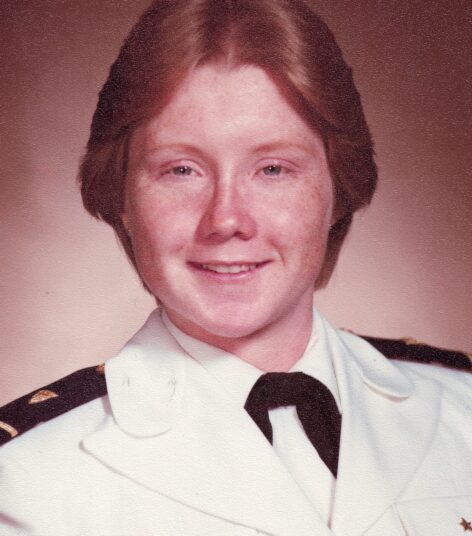
The Academy, Hays said, simply wasn’t ready, structurally or socially. Congress had mandated women’s admission only months before her class arrived. There were only two women’s bathrooms for 12 platoons. Showers had no stalls. Her first engineering project was designing divider spacers so people walking past wouldn’t see straight into the showers.
“When I suggested this, I was looked at like I had three eyes,” she laughed. “It was such a simple thing.”
There was also a rule: no more than three women could gather at any one time, except for official functions. The men faced no such limit.
“If four of us got together, the upperclassmen would come by and say, ‘You can’t stay together,'” she said. “They didn’t want us meeting or banding together.”
Despite the unrealistic expectations, Hays put her head down and persevered. She graduated 31st in her class of 153.
A ship of 70 men
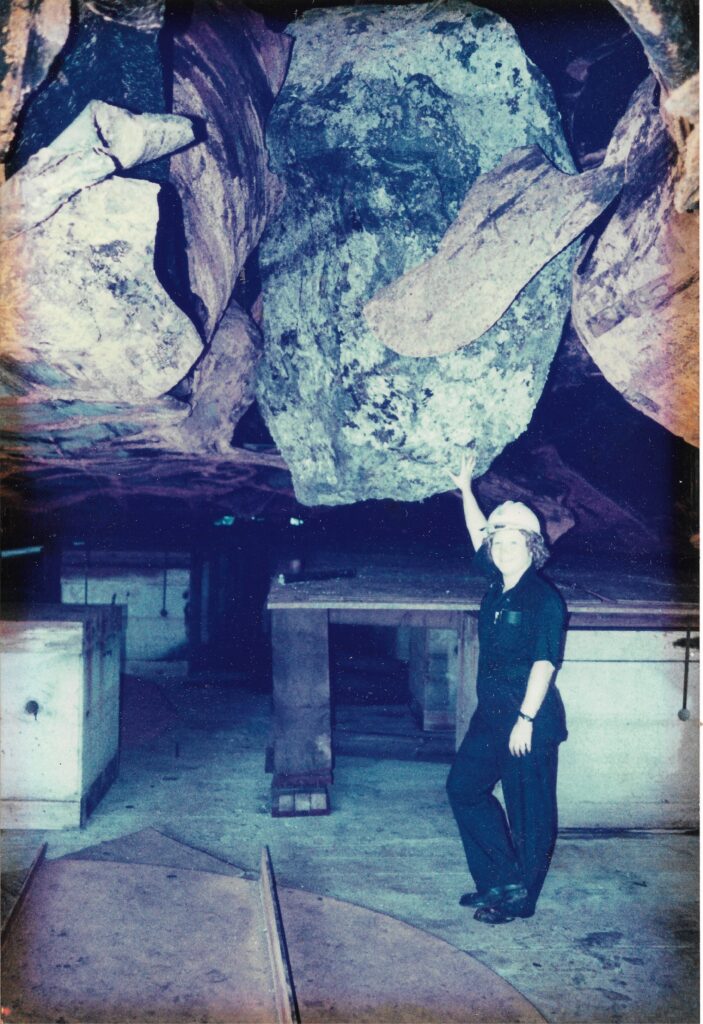
Standing beneath a piece of Bligh Reef still lodged in the Exxon Valdez after the tanker arrived at NASSCO San Diego Drydock for repairs. As Cargo Division Staff Naval Architect at the USCG Marine Safety Center, Karen served on the NTSB investigation team and helped assess the vessel’s damage—work that informed the OPA 90 double-hull rule debates on Capitol Hill. Earlier, she joined salvors aboard the Exxon Valdez at Naked Island in Prince William Sound to evaluate her structural integrity before the transit south.
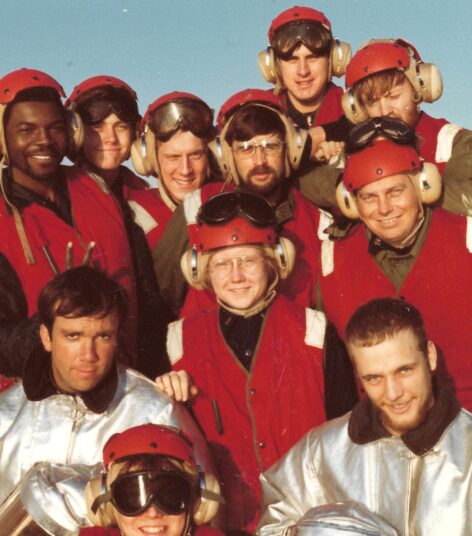
Her class rank earned her a two-year engineering billet on a 210-foot Coast Guard cutter out of New Hampshire. She was the first woman assigned to serve on board the USCGC Decisive, with 70 men and only one other woman on board for part of the time. The crew stole her clothes from the washing machines, ran her underwear up the flagpole, and refused to train her on engineering tasks she was expected to learn.
“They expected me to know how to do all of this stuff without having the opportunity to learn,” she said. “They faulted me for not knowing. The expectation was so much higher.”
She dug her heels in.
When Coast Guard Naval Engineering didn’t open doors for her, she pivoted into Marine Safety. The Coast Guard sent her to Port Arthur, Texas, widely considered the least desirable port in the fleet, but ultimately an unexpected gem.
“From a professional standpoint, it was the best place to be,” she said. “They had everything there. I loved welding, and they had major problems from a welding standpoint. I was in heaven.”
She met her future husband, Don, on a helicopter flight to an offshore platform. He was the pilot. Her job, as the junior inspector, was to ride up front and keep him awake.
Two master’s degrees, two babies, three years of night school
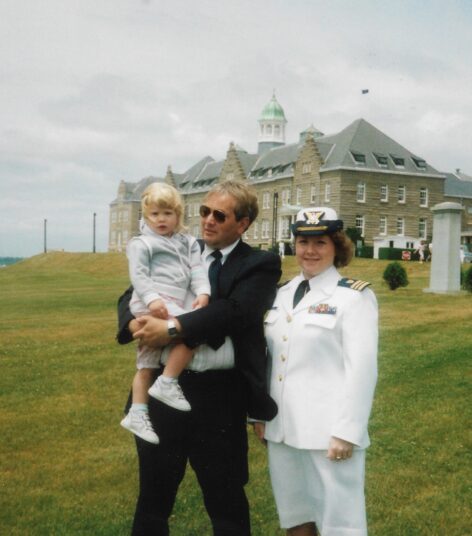
The Coast Guard then sent Hays to MIT, where she earned two master’s degrees in two years: one in naval architecture and marine engineering, one in materials engineering, welding, fracture mechanics, and non-destructive inspection. She got married halfway through. Her professors disapproved.
She was assigned to Washington, D.C. and served as the first member of the Coast Guard Marine Safety Center’s Salvage Engineering Response Team for the Exxon Valdez grounding. At Coast Guard headquarters, she took on a senior technical role in which she drafted the Alternate Compliance Program, which transferred the responsibility for vessel inspections from the Coast Guard to the American Bureau of Shipping. She finished it four days before her second daughter was born.
At the same time, she was attending the Naval War College at night, a three-year program, while also raising two small daughters and a teenage stepson.
“I was busy,” she said. “I was young. I could do all that.”
Her husband, by then flying medevac helicopters for a Washington, D.C. hospital, was landing in some of the most dangerous neighborhoods in a city then known as the murder capital of the country. After six years, he wanted a change. The family took a leap and moved to the Pacific Northwest.
A plank owner at Alaska Tanker Company (ATC)
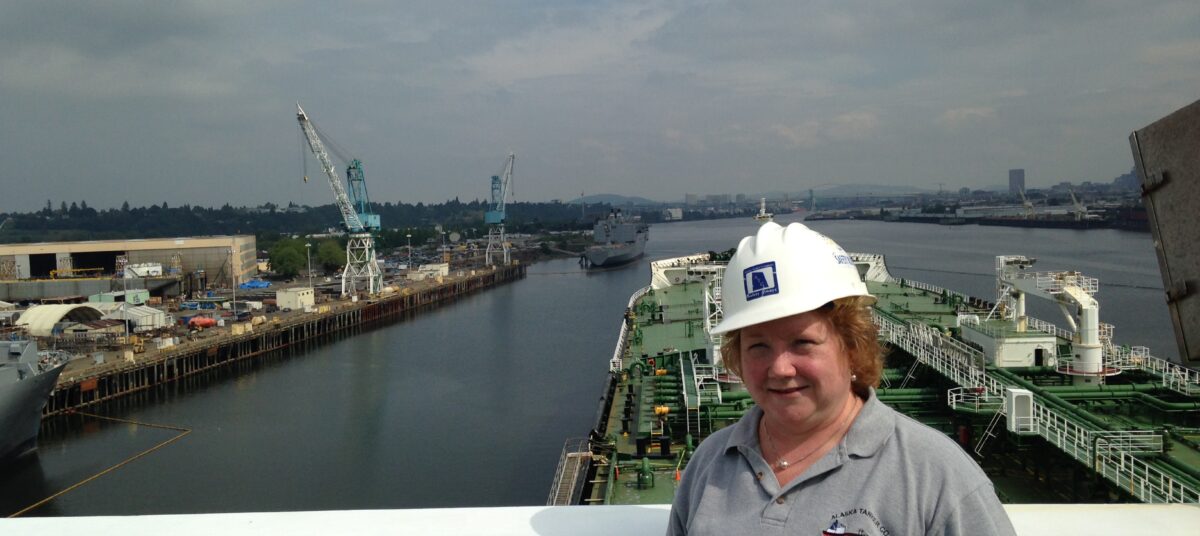
In 1996, Hays retired from the Coast Guard and took a state job before joining ATC the day the company opened its doors in April 1999. Founded to bring a stronger safety culture to U.S.-flagged tankers serving Alaska, ATC began with 66 employees and 11 of the oldest U.S.-flagged tankers in the world.
“There were tons and tons of spills on those old ships,” she said. “My job was to figure out how to stop them. How do you change the culture?”
Hays led ATC’s certification to ISO 14001, making it the first U.S. shipping company to earn the environmental management standard. She managed the effort to earn Washington State’s ECOPRO certification and win the Coast Guard’s Benkert Gold Award, an industry first for a U.S. tanker company. She helped adapt DuPont’s safety pyramid into a spill-prevention pyramid, still used by ATC today, by tracking small loss-of-containment events to prevent the catastrophic ones.
While peer companies set higher volume limits, reporting only 20 loss-of-containment events a year, ATC set the bar at a much lower volume. We began tracking 500 or 600 events each year, seeing reporting of small incidents as a leading indicator, flattening the pyramid, and in doing so, changing the culture to not tolerate any loss of containment.
“Whenever someone tried to get us to change our definition, I dug in my heels,” she said. “Not only no, but absolutely not.”
Last year, ATC’s Alaska Legend was recognized at the Saltchuk Safety Awards for 18 years without an incident. Since their construction was completed in 2008, none of the ATC’s four Alaskan Class tankers have had an oil spill to sea.
“BP started ATC for a reason,” Hays said. “We turned around what was a bad situation. That’s what I’m most proud of.”